Eccentric training: why the lowering phase matters for strength as you age
Two new studies suggest slow, controlled lowering work can build leg strength and everyday function in older adults. Here’s what they found and what they don’t show.
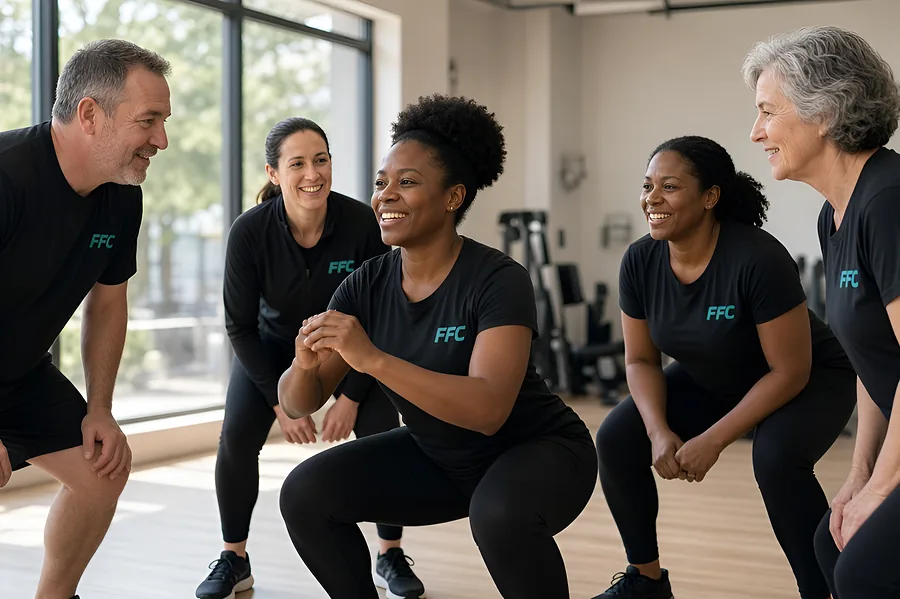
Every rep you do has two halves. There's the lifting part, when the muscle shortens, and the lowering part, when it lengthens under load. That second half is called the eccentric phase, and it's easy to rush. You let the dumbbell drop, you fall into the bottom of a squat, you sit down heavily on a box.
Two papers published on 15 October suggest the lowering phase deserves more attention, especially as we get older. Both look at older adults, and both point the same way: deliberately loading the eccentric part of a movement appears to build leg strength and help with everyday tasks.
The 12-week study
The first is a study in Scientific Reports from researchers at Seoul National University in South Korea. Thirty-seven older adults living in the community, with an average age of about 70, did supervised eccentric training twice a week for 12 weeks on a specialist machine called an Eccentron.
According to the published abstract, their body weight and BMI didn't change, but their skeletal muscle mass went up, as did the size of their thighs and calves. They also got better at two practical tests: the timed up-and-go test, which measures how quickly you can stand from a chair, walk a short distance and sit back down, and a stair-climb test.
The team also took small muscle samples from the thigh and looked at individual muscle fibres. The fibres became stronger for their size, even though they didn't get any bigger. The authors describe this as among the first studies to show this kind of change at the single-fibre level in older adults.
The bigger picture
The second paper is a systematic review and meta-analysis in the 15 October issue of Experimental Gerontology (it first appeared online in August). The authors pooled 15 randomised controlled trials involving 438 older adults, looking at what they call eccentric overload training: methods that load the lowering phase more heavily than the lifting phase.
Their conclusion was that this kind of training "shows promising potential" for lower-limb strength and explosive power. It beat doing nothing, and it was at least as good as conventional resistance training. Programmes lasting eight weeks or more gave bigger improvements. Training more than twice a week seemed better for strength, while twice a week or less seemed better for power. Flywheel machines, a type of equipment that loads the lowering phase, came out particularly well in the subgroup analysis, though the authors flag that this was exploratory.
What it means in practice
You don't need an Eccentron or a flywheel to use the idea. Most of us can bias the lowering phase with what's already in the gym or at home:
- Take your time on the way down. On squats, lunges, leg presses and step-downs, try lowering for a slow count of three or so, then come back up at a normal pace.
- Control the bottom of sit-to-stands. Lowering slowly to a chair, rather than dropping into it, is a simple eccentric exercise that mirrors something you do every day.
- Step down, not just up. Slow, controlled step-downs from a low step load the front of the thigh in its lengthening phase.
- Progress gradually. As with any strength work, add load, reps or tempo a little at a time. Our progressive overload guide explains how.
Eccentric work tends to cause more muscle soreness at first, particularly in the first few sessions, so start lighter than you think you need to. If you're new to lifting, our squat technique guide is a good place to start.
The caveats
These are encouraging findings, but they have limits. The Korean study was small, at 37 people, and used one specialist machine under supervision, so we can't assume the same results from home exercises. The meta-analysis rated its evidence as moderate certainty for strength and high certainty for power, and some of its most specific findings, such as the flywheel advantage, came from exploratory subgroup analyses. Neither paper looked at people under about 60, though the principle of controlled lowering is a normal part of good training at any age.
It's also worth remembering the basics. The NHS guidelines for older adults recommend activities that improve strength, balance and flexibility on at least two days a week, alongside at least 150 minutes of moderate activity. Eccentric training is one way to make those strength days count, not a replacement for them.
If you have a health condition, a joint problem or you haven't exercised for a while, speak to your GP or care team before starting a new strength programme. If you'd like a structured place to begin, our beginner 3-day gym plan builds the main lower-body movements step by step.
This post is general information, not medical advice. If you have a health condition or concerns, speak to your GP or another qualified professional before changing how you eat or exercise. Read our health and fitness disclaimer.